Claude Debussy
French, 1832–1905
La mer (“The Sea,”1903–05)
I. De l’aube à midi sur la mer (“From dawn to noon on the sea”)
Recommended recording: Anima Eterna Brugge, conducted by Jos van Immerseel (Zig-Zag Territoires, 2012) | Listen on YouTube | Listen on Spotify
Claude Monet
French, 1840–1926
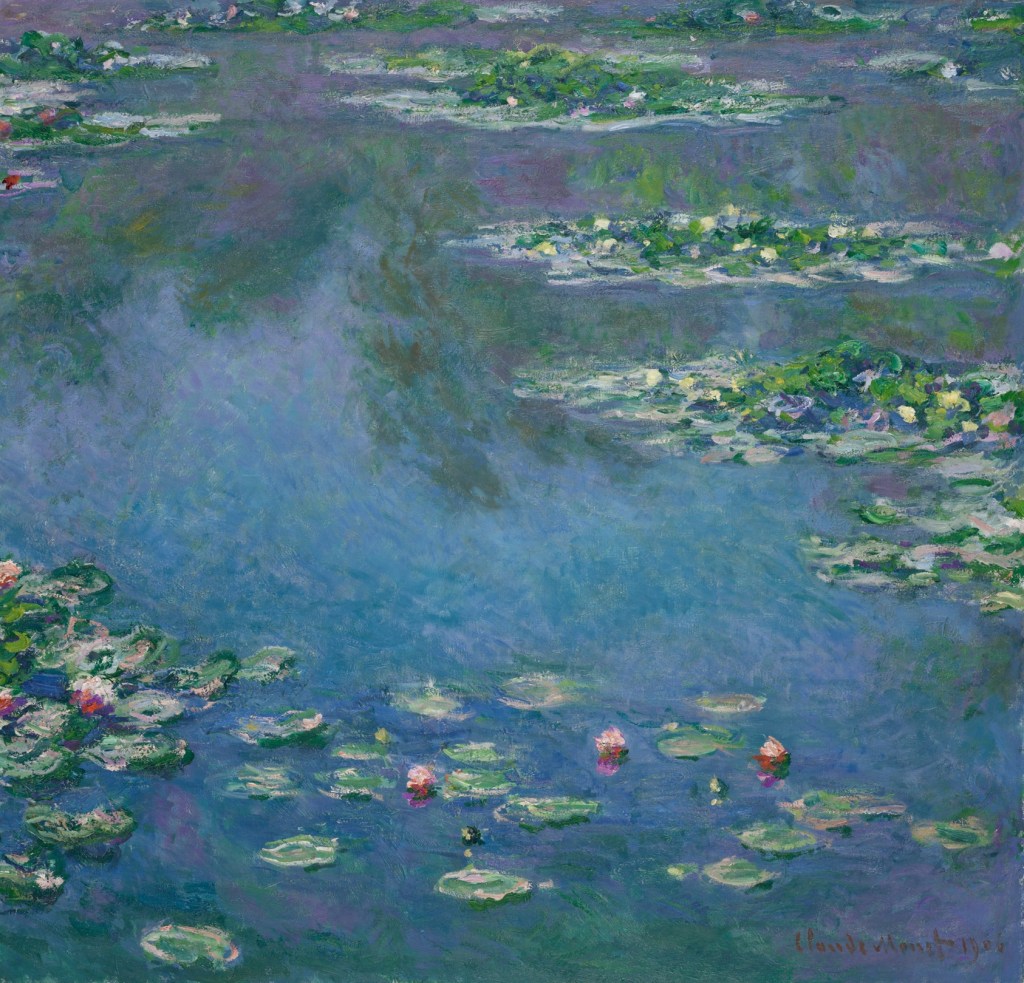
Water Lilies (1906)
Oil on canvas
Art Institute of Chicago | View work online
Public domain, via Wikimedia Commons
For the last three decades of his life, Monet devoted himself almost obsessively to a single subject: the water-lily pond in his garden at Giverny, which he painted in some 250 variations. One particularly striking example is the 1906 Water Lilies, now housed at the Art Institute of Chicago.
Rather than presenting a narrative scene or a well-defined landscape, Monet uses quick, visible brushstrokes and a luminous palette to convey the fleeting effects of light, color, and reflection, emphasizing perception over precise depiction. This focus on atmosphere and the ephemeral effects of light lies at the heart of Impressionism, a late-19th-century movement that emerged as a reaction against the polished clarity of French academic painting. The Impressionists treated painting not as a perfected representation of the world, but as an evocation of a single moment.
Monet was also influenced by Japonisme, a 19th-century European engagement with Japanese art and aesthetics, especially ukiyo-e woodblock prints. Monet collected these prints and incorporated their flattened pictorial space, asymmetrical compositions, and emphasis on surface pattern when designing and painting his water garden. By 1906, Monet had pushed this flattening further still, dispensing with the horizon line entirely and looking straight down into the pond’s surface, leaving nothing but water, reflection, and floating water lilies to fill the canvas.
The term Impressionism, originally coined to describe painting, was later loosely applied to music that favors atmosphere, timbre, and perceptual experience over clearly articulated melody, harmony, and rhythm. Debussy himself resisted the label, feeling a closer kinship with Symbolist poets like Stéphane Mallarmé, for whom suggestion and ambiguity were artistic ends in themselves. Like Monet’s Water Lilies, the Impressionist works of Debussy, such as La mer, aim to evoke rather than depict.
In the first movement of La mer, titled De l’aube à midi sur la mer (“From dawn to noon on the sea”), Debussy layers melodic fragments, rippling gestures, and continuously evolving orchestral colors, allowing sound to ebb, shimmer, and surge like light across water. Rhythm is fluid and flexible; instead of foregrounding a driving pulse, Debussy treats rhythm as something that breathes, drifts, and reshapes itself.
For Debussy, harmony functions less as a system of tension and release and instead becomes a field of color and atmosphere. He often uses modal, whole-tone, and pentatonic inflections rather than major-minor tonality, and chords are frequently treated as coloristic sound objects rather than steps in a linear harmonic progression.
When Debussy does invoke major-minor tonality, the effect can be striking. Toward the end of the first movement of La mer, for example, a languid, harmonically ambiguous section built around the whole-tone scale (7:05 in the recording by Anima Eterna) gives way to a stable arrival on G-flat major (7:56)—only to unexpectedly modulate seconds later to D-flat major (8:17) in a radiant conclusion.
Like Monet, Debussy was influenced by aesthetic principles of Japonisme—the idea that art can suggest rather than state, and that silence and negative space are as meaningful as what fills them. For Debussy, a fleeting impression can be a complete statement. This invites the listener to dwell within a single moment and situates listening as an act of discovery.
© 2026 Troy Etter
 Music & Art